Former Vietnam POW
Scotty Morgan talks about John McCain
“John served honorably as a
POW...but I’ll never vote for him for President”
Part I: Mission of No Return
Retired U.S. Air Force
Colonel Scotty Morgan has a near-photographic memory of certain parts of his
eight and a half years as a Vietnamese Prisoner of War. He remembers his 122nd
combat mission in Southeast Asia on April 3rd, 1965. He remembers
being shot down, evading capture for two days, being captured, and tortured.
And he remembers fellow POW
John McCain.
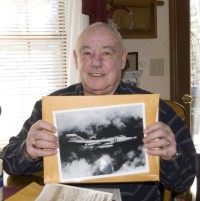
A native of Candler, Morgan
was the fifth American pilot shot down in the Vietnam War. The Tribune
interviewed him recently at his home in West Asheville. For more than two hours
we questioned him about his time as a POW, his knowledge of then-Lieutenant
Commander John McCain, and the presumptive Republican Presidential candidate’s
loyalty to his country and to his fellow POW’s.
Morgan started the
conversation by observing the date of our interview was February 11. “On 12
February 1973, I departed North Vietnam on the first airplane out of there, on
the first C-141 Starlifter I had ever seen. I had been flying in Vietnam since
1963. On the 3rd of April, 1965, our mission was to get a Battle
Damage Assessment on the Hamrong Bridge. It was the first raid on the bridge.
The Air Force put 48 airplanes on that bridge that day. We had a secondary
target, a radar site under construction. We were flying supersonic RF-101
Voodoo fighter jets out of Ton Son Nhut airbase in Saigon. We refueled at
Yankee Point. Our secondary target was laid on earlier in the day by some
little fat Intelligence officer who wanted another photo even though they had a
perfectly good one from the previous day. I know his name was Rose. I haven’t
seen him since that day and I’m not particularly looking forward to ever
meeting him again.
“I had a wing man who started
out with me that day. He wasn’t able to take on fuel. I took him on up North
and told him he could recover at Da Nang airbase, and that I would go on down
to low level and take some pictures of the bridge. I got those.
“We had four other targets to
pick up on that mission. However, I got up hit. I was down in the weeds – they
can’t hit you in the weeds – but I pulled up to 200 feet to get the pictures.
They can hit you at 200 feet. The terrain was rather hilly, jungle terrain. The
target was Northwest of Vinh. I pulled up and saw the target off to the right
about 30 degrees, I turned towards it and the sky lit up like a Christmas tree.
I felt three thumps in the rear end of the airplane and all the red lights lit
up. The stick was dead. Nothing. There was no control over the airplane. I
said, ‘What a hell of a way to go.’
“The last thing I saw I was
looking right straight down in the top of a tree, and I reached down and
squeezed the handles and the next thing I knew I was hanging under the
parachute. The airplane came out from under the canopy of the parachute and hit
a mountain to the west of us and went up in flames. When I saw the airplane the
tail was missing. They had shot the whole tail off the airplane. When I saw it,
it was tumbling end over end, not rolling side to side.
“When the parachute canopy
came open I was going rather fast and I blew out two of the 30 Nylon panels.
That makes you come down rather fast in a 35-foot parachute. I came down
through a tree on a very steep hill and hit the ground hard with my feet,
twisting my ankle. The tree sprang back up and I ended up hanging there, about
six inches off the ground. I evaded for about two days and got caught trying to
get water, probably by the militia. They had all the streams blocked and had
shelters about every 30 feet. I was at the creek when I looked over and saw a
militia member sitting in his lean-to. He didn’t see me. I started to back away
but walked right into a guy carrying a muzzle-loading shotgun with two women
carrying rice and water.
“That was it. They took me
down to Vinh and interrogated me twice, rather harshly, two times on April 6,
then the put me in a vehicle and carried me up to the Hanoi Hilton. I was the
first occupant of the part named Heartbreak Hotel.
“Smitty Harris was shot down
the same day I was. He came into my cellblock and asked me what I called it,
and I named it on the spot. He is married to Louise, an Asheville girl who
graduated from St. Joan of Arc.
“I was in Heartbreak, in
solitary, and the first person after me in Heartbreak wasn’t Smitty, it was
Phil Butler, a Navy pilot, sometime in the middle of April. They moved him out
and moved Smitty in. I made contact with him. I stayed in Heartbreak, mostly in
solitary, until August. I did get a cellmate for a while but it didn’t last
long. Ron Stores came in sometime in July for a day or two, but Ron and I had
serious conflicts with the guards and they separated us. They didn’t like the
way we conducted ourselves. We told them what they could kiss.
“Ron died in captivity, I
think in 1971. He was a very strong guy, and he gave the Vietnamese a very
tough time. He didn’t go along with their program. I really liked him.”
“On a typical day, the gong
would go off about five in the morning. Then they turned on the state radio,
music with half-notes that would drive you crazy, and then the propaganda
started. That was how they controlled their people. In 1966 they started piping
in their English language Radio Hanoi broadcasts. We learned that no matter
what they said, they had it backwards. Their propaganda was always strong, and
wrong.
“At some point each morning
they’d bring you a pitcher of hot water. They’d pour it through the peepholes
and it would burn your fingers and feet. The water was all you got for the day,
for bathing and for drinking. We caught it in an earthenware cup.
“At first they brought us
Western style food. They stacked containers that looked like lunch pails. They
had a slice of bread in them, and maybe a small piece of meet in those early
days. Maybe a slice of potato if you were lucky. After that, we’d wash the
dishes in whatever water we had left. At that time in Heartbreak there was a
cell with an old showerhead. You took care of your toilet needs in a bucket and
dumped it there. When I first got there my rusty old bucket didn’t have a lid
on it, but that was OK because they had a 25 watt bulb in there that burned all
the time. You dumped your bucket there and sometimes they’d let you take a
shower there.”
Morgan said he kept track of
the number of prisoners in the prison by counting the lunch pails that were
brought in on bicycles each day.
“I had to chin myself up on
the window ledge to see out it,” Morgan recalls. “There were more and more
every day.”
Morgan said the Special
Forces raid at the Son Te prison camp in November, 1970, about 20 miles from
Hanoi, really scared his prison guards.
“Unfortunately the Son Te
camp was empty when the raid occurred,” Morgan said. “All the people from Son
Te were at Camp Hope. Ho Chi Minh had died and our treatment was getting
somewhat better. We were being let outdoors until the raid, and that scared the
hell out of them. After the raid they piled us into vehicles and took us back
to the backside of the Hilton to what we called Camp Unity. They had large
cells there, with concrete slabs for beds. We had about 56 people there at one
time. They were big concrete pads, higher in the center. They gave you a straw
matt and you lined up across there. We rigged up some lines to put up mosquito
netting.
“We got there in 1970, and we
had a little insurrection in the prison. They had about 350 POW’s in Camp Unity
at that time and we got organized. Then we got a little belligerent. They sent
36 of us to what was supposed to be a punishment camp, a torture camp, we
called it Skid Row. They decided they weren’t going to go through with it,
however, and brought us back into Camp Unity.
I was in there with John
McCain for three to six months, I’m not sure, you know how it goes. John was
basically not different from any other POW. You could tell he’d been injured,
but a lot of guys had.
John McCain, as far as I’m
concerned, conducted himself in an honorable manner. I’ve never heard anyone
who was there say differently.
“There is a bunch of crap
going around the Internet. One story says the communists provided him with
women downtown in a hotel. That’s a damn lie. He never left the prison. He had
a bunch of cellmates at all times. It’s like the story going around about Jerry
Driscoll handing Jane Fonda a note of some sort, and her turning it over to the
guards, and him getting a beating. That didn’t happen. I know Jerry Driscoll,
and he has spent years telling people the story isn’t true. Some people don’t
want to hear the truth.”
By 1969, after Ho Chi Minh
died, Morgan said that with few exceptions there was no more torture in the
prison camps. A few people were tortured, and they would slap people in leg
irons for a time.
“When he died I was at the
Zoo Annex. I was in manacles and had been for 50 days. The Annex is a different
prison, South of Hanoi, next to the Hanoi Zoo. It’s where the people were
behind bars and the animals looked at them.”
McCain came into the prison
system on Oct. 26, 1967.
Regarding McCain, Marine
Corps Captain Orson Swindle III, who slept next to McCain in one of the large
cells for more than a year in the Hanoi Hilton, said that when he read
commentaries on the Internet disparaging McCain’s time as a POW, he “was
horrified. I didn’t find anything (criticism) out there that was based in
fact.”
NEXT WEEK: McCain in the
Hanoi Hilton and why Morgan and many other former POW’s are not supporting him
for President.
Story filed by Bill
Fishburne, Senior Editor of the Tribune Papers
-----------